 One of the most enjoyable aspects of working in archives is being able to delve into the everyday lives of individuals. Material is often at its most rewarding when it’s personal, as in the case of two scrapbooks formerly belonging to the splendidly-named Sir Jethro Justinian Harris Teall (whom you may remember from an earlier advent blog post), now located in the Geological Society’s archive.
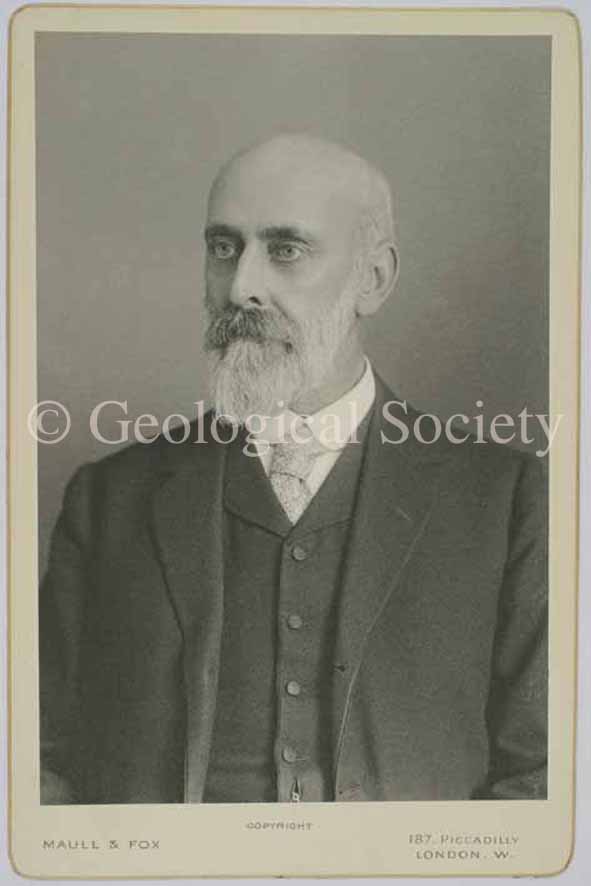
Fabulously named Jethro Justinian Harris Teal
Teall was elected Fellow of the Geological Society in 1873, was President between 1900 and 1902, and received the Wollaston medal in 1905 [1]. He was also present for, and assisted in the arrangement of, the Society’s centenary celebrations [2].
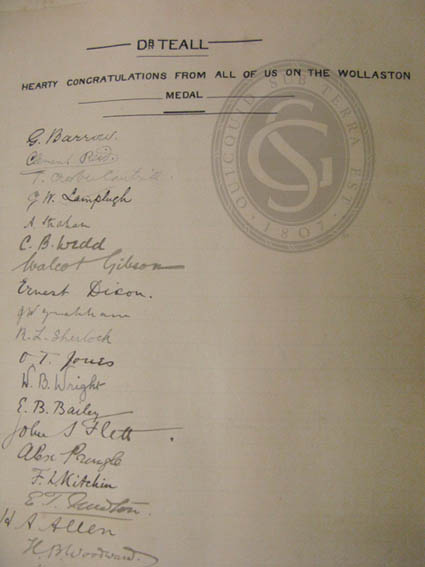
[1] Note signed by other Geological Society Fellows congratulating JJH Teall on being awarded the Wollaston Medal (1905)

[2] Newspaper cutting mentioning JJH Teall’s involvement in the Geological Society’s centenary celebrations
Teall seems to have been an upper middle class character, member of the Athenaeum Club and parent of sons educated at Dulwich College and Cambridge. He was invited to attend a variety of society events, sometimes with his wife Harriet, including significant national occasions. At these events the couple had the opportunity to associate with distinguished figures.

[3] Seating plan for a dinner at Oxford celebrating the conferment of honorary degrees (1908)
On the occasion of the conferment of Teall’s honorary doctorate from Oxford in 1908, for example, the Prime Minister of Nepal was present, and Teall sat four seats away from David Lloyd George [3], at that time Chancellor of the Exchequer. He also attended a garden party at Windsor Castle [4].

[4] Invitation to an afternoon party at Windsor Castle (1912)
This was not his only brush with royalty – he was present for both Edward VII’s funeral [5] and the coronation of his successor, George V [6].

[6] Programme for George V’s coronation (1911)

[5] Invitation to Edward VII’s funeral (1910)

[7] Invitation to ‘An Adieu to Dorothy Eden Burrell’ (1905)
As well as grand events like the funerals of kings, Sir Jethro and his family attended more everyday gatherings. This invitation to an event called ‘Adieu to Dorothy Eden Burrell’ [7], appears to be a genteel Edwardian equivalent of a hen party, held two days before Dorothy’s marriage.

[8] Photo taken at 6am following a dance at Sidney Sussex, Cambridge (1905)
Meanwhile this photo, taken at 6am following a Sidney Sussex College dance, is a much smarter version of the ‘survivor’s photo’ sometimes taken the morning after university events today [8].
The Teall somewhere in the above photo is likely to be Frederic Hathaway Teall, Sir Jethro’s younger son. Large parts of the scrapbooks are given over to Frederic’s activities, mostly recording his hurdling prowess at Cambridge and his subsequent life in the Egyptian civil service. The compiler of these volumes, whether it was Sir Jethro or his wife, seems to have collected almost every newspaper cutting and photo relating to Frederic’s participation in 120 yard hurdle races, of which this is just one example [9]. The hurdles are wooden and embedded into the ground – meaning it would have been incredibly painful if the athletes judged their jump wrongly!

[9] F Teall (on the far left) competing in the 120 yard hurdles (1903)
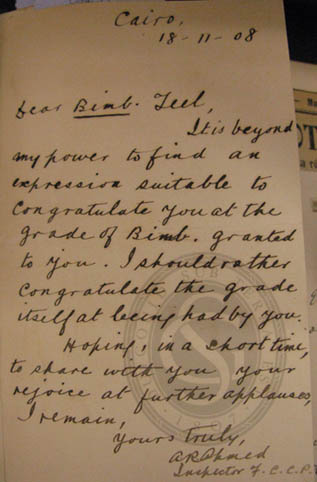
[10] An effusive letter congratulating F Teall on his promotion to a new rank (1908)
Frederic Teall was accepted into the Egyptian civil service in 1905, with the scrapbooks documenting his various promotions [10]. In Egypt Frederic appears to have replaced hurdling with tennis, participating in tennis tournaments between Cairo and Alexandria, and as a member of the Gezira club, the oldest sporting club in Egypt, located on an island in the Nile [11].

[11] Newspaper cuttings showing F Teall’s results in a Cairo tennis tournament (1922)
Like his father, Frederic associated with high society, in his case in colonial Egypt. While the First World War was drawing to a close in Europe, on the other side of the Mediterranean Frederic Teall and his wife were being invited to a soirée by the Sultan at Ras el-Tin Palace in Alexandria [12]; a residence that is still in use today.
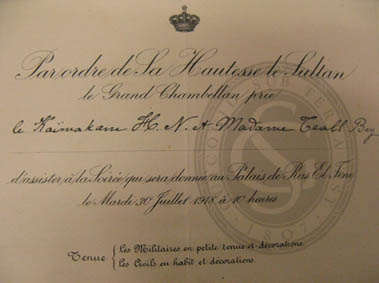
[12] Invitation to a soirée at Ras el-Tin Palace, Alexandria (1918)

[13] Letter inviting F Teall’s wife to Abdeen Palace to meet the Sultana of Egypt (1922)
It appears that Frederic’s wife Marjorie was personally known to the Sultana of Egypt, Nazli Sabri. In this handwritten note [13], Marjorie is invited to Abdeen Palace, Cairo, the following day to meet her. If your French is a little rusty (or non-existent), the letter roughly reads as follows: ‘Monday 13th March 1922. Dear Madame. Her Gloriness The Sultana will have the pleasure to receive you tomorrow Tuesday, the 14th March at 5 o clock PM at Abdeen Palace. Yours sincerely, […]’. Interestingly, two days after this letter was written, Egypt’s Sultanate ended and the Sultan and Sultana were renamed the King and Queen (the UK had declared the country’s independence, with certain conditions, two weeks earlier). This, therefore, may be one of the last documents referring to Nazli as the Sultana.
The scrapbooks contain far fewer items relating to Sir Jethro’s elder son, George Harris Teall. From what they do hold, it is evident that he was a military man of the Lincolnshire Regiment, serving in places such as Malta and east and west Africa. He married Josephine Burrell, youngest sister of Dorothy Eden Burrell, whose ‘adieu’ is mentioned above. The Burrell family were part of Charles Burrell & Sons, a large and successful manufacturer of steam-powered engines, now commemorated in the Charles Burrell Museum, Thetford, Norfolk. They seem to have been family friends of the Tealls years before the marriage of George and Josephine, with several pages of the scrapbooks relating to Elsie Burrell, the middle daughter.
Elsie, according to various newspaper cuttings in the scrapbook, was a ‘brilliant’ and ‘clever’ watercolour portraitist, depicting stars of the day such as Gerald du Maurier, Irene Vanbrugh, and Gladys Cooper [14], as well as Sir Jethro’s wife. She had a very brief first marriage; after marrying a Major Cuninghame in July 1916 and returning to his home in Rhodesia, he died the following March of typhoid fever. Even during wartime, tabloid newspapers were intrigued by lady’s fashions, as this image [15] – with the headline ‘Wears Monocle’ – shows! After managing her late husband’s large Rhodesian ranch for several years, she married Lieutenant-Colonel Sir Randolf Baker Bt., a former MP.
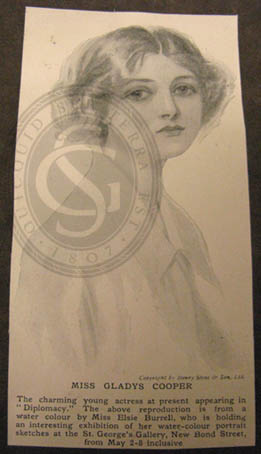
[14] Newspaper reprint of a watercolour of Gladys Cooper, by Elsie Burrell

[15A] Top part of newspaper cutting showing Elsie Burrell wearing a monocle (1916)
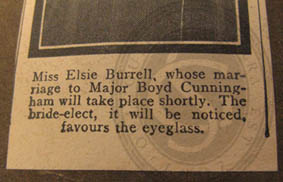
[15B] Bottom part of newspaper cutting showing Elsie Burrell wearing a monocle (1916)
If you were wondering whether there was going to be any festive content in this notionally ‘advent’ piece, I’ve saved it until last! Here’s a Christmas message from elder son George, when stationed in Malta, to his parents…
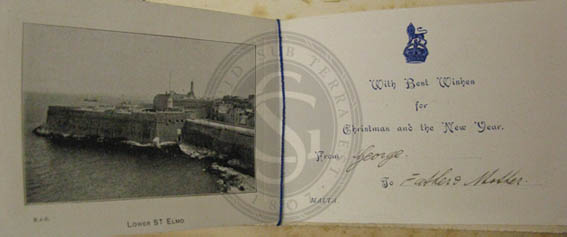
[16] Christmas card sent from Malta by G Teall to his parents
 The Geological Society Blog
Pingback: Door 24: A christmas letter from the geoadvent blog team | Geological Society of London blog